Monday, October 27, 2008

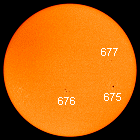
The Sun is BLANK

There have been no Sunspots since the 16th when Sunspots 1005 and 1006 showed up.
Following these spots was a magnetic band threatening to break the surface and become
more Cycle 24 Sunspots.
The bands can be seen here via a Magnetic telescope.
NASA is calling these Cycle 24.

CREDIT SOHO
This is good news, more magnetic blemishes mean that the Sun is warming up, we should start seeing more Sunspots in a couple of months.

Tuesday, October 21, 2008

Solar Minimums and Economic Minimums

I have been thinking about the cycles that the Sun goes through. They seem to correspond with the economic cycles. When you look at the lows on the solar cycle chart they line up with economic troubles. I wonder if we will start seeing the economy recover when Cycle 24 starts up.


Credit NASA

Monday, October 6, 2008

Only one Sunspot this Week

The last sunspot was no.1003 on October 5th. This may seem like no big deal but when you look at years past we see many more sunspots. On October 5th 2004 we had 3 sunspots.


Credit SOHO/MDI October, 5th 2004


The surface of the Sun may not be active, but the solar winds are.

This photograph was taken Saturday night, Oct. 4th, in Russia's Kolyskia Peninsula by Aleksander Chemucho. When it started raining it was green.

Credit Aleksander Chemucho


Tuesday, September 30, 2008

Two new Sunspots are Forming

The pair of spots are easier to see on this magnetic map.

Credit: SOHO/MDI

Scientists are not saying if these spots are Cycle 23 or 24.
Two spots at the same time is a good sign. We have not seen this much
activity for months.

Thursday, September 25, 2008

Tuesday, September 23, 2008

NASA to Discuss Conditions On And Surrounding the Sun

NASA has scheduled a meeting for today at 12:30 p.m. EDT.
They are going to discuss the data from NASA and European Space Agency Ulysses mission.
This data will show that the solar wind is at a 50-year low.

The sun's current condition could result in changing conditions in the solar system. -NASA

THIS COULD BE AN END TO THE FAKE GLOBAL WARMING. -ME

My wife got upset at me last night for talking about the stock market and the cold sun.
She said that I always talk about bad things before we go to bed and then she can't sleep.
We have never seen these major changes in our lifetimes.

This small Sunspot is being classified as a member of cycle 24.
Image credit: SOHO/MDI

Thursday, September 18, 2008

My New Website

This is my new website project for my writing for new media class.
I will be updating it this weekend, it will be completed by next Tuesday.


On a lighter note, no activity from the Sun.

Tuesday, September 16, 2008

21 SunSpots this Year


The Sun has continued to be quiet. We have seen only 21 Sunspots this year.

I am predicting an unusually cold winter.

From Jan. 2007 to Jan. 2008 the global temperature dropped .595 Celsius that is a 1.071 Fahrenheit drop.

I am curious to see the results in January of 2009.

I hope you enjoyed the harvest moon.

The full moon nearest the
autumnal equinox (about September 23). Near the time of the autumnal equinox, the angle of the moon’s orbit relative to the Earth’s horizon is at its minimum, causing the full moon to rise above the horizon much faster than usual. Since the difference of the moon’s rising time on successive nights barely varies, the moon appears to rise at nearly the same hour for several nights in succession. Because the harvest moon, like any full moon, must rise near the hour of sunset, harvest workers in the Northern Hemisphere may be aided by bright moonlight after sunset on several successive evenings. A similar effect is observed in corresponding southern latitudes around March 21. -www.britannica.com

Friday, September 12, 2008

We Have a SunSpot!

Sunspot 1001 is small, but large enough to get a number.


Here is something interesting. The Mars lander photographed some small dust devils.
The whirlwind in this animation is approximately five meters in diameter. - NASA


Monday, September 8, 2008

The Solar Winds are Blowing

People up in Canada and Iceland are getting some beautiful Aurora photos. The Sun may not be active on the surface, but the Solar winds sure are bringing in some lovely September green.


See more in the Aurora Photo Gallery


What is an Aurora?

Auroras are produced by the collision of charged particles from Earth's magnetosphere, mostly electrons but also protons and heavier particles, with atoms and molecules of Earth's upper atmosphere (at altitudes above 80 km (50 miles). The particles have energies of 1 to 100 keV. They originate from the Sun and arrive at the vicinity of Earth in the relatively low-energy solar wind. When the trapped magnetic field of the solar wind is favourably oriented (principally southwards) it reconnects with Earth's magnetic field, and solar particles enter the magnetosphere and are swept to the magnetotail. Further magnetic reconnection accelerates the particles towards Earth.
The collisions in the atmosphere electronically excite atoms and molecules in the upper atmosphere. The excitation energy can be lost by light emission or collisions. Most aurorae are green and red emission from atomic oxygen. Molecular nitrogen and nitrogen ions produce some low level red and very high blue/violet aurorae. The light blue colors are produced by ionic nitrogen and the neutral nitrogen gives off the red and purple color with the rippled edges. Different gases interacting with the upper atmosphere will produce different colors, caused by the different compounds of oxygen and nitrogen. The level of solar wind activity from the Sun can also influence the color of the aurorae.


The Sun is Blank again.